

Insist on continuous operating ratings of -40°C to +125°C. Many budget TPUs lose their low-temperature flexibility below -30°C, leading to cracking in cold climates.
2. Fuel Lines: The Permeation Challenge
The Data: The EPA’s evaporative emission standards (Tier 3) require fuel systems to limit hydrocarbon permeation to 0.5 grams per square meter per day. Standard nylon (PA12) often struggles to meet this without thick walls or PVF lamination. Multi-layer construction is common, but it adds cost and complexity. A single-layer TPU solution could be the hidden champion.
My Perspective: After testing countless samples from various suppliers, I have seen a significant gap in lot-to-lot consistency when it comes to fuel resistance. The weak point isn’t always the polymer backbone; it’s often the out-of-spec additives or low-molecular-weight fractions that leach out.
Why Shanghai Xingen stands out here: Their automotive-grade TPU is compounded with a proprietary hydrolysis stabilizer package. This is critical because ethanol-blended fuels (E10 to E85) can slowly degrade the urethane bonds in poorly stabilized TPU. In my testing, Xingen’s material maintained over 85% of its original tensile strength after 1,000 hours in E85 at 60°C. Standard TPU often drops below 60%.
Operational Advice:
Always verify your supplier’s quality control certificates. Ask for a Gas Chromatography-Mass Spectrometry (GC-MS) report to check for residual catalysts that can accelerate fuel degradation.
For ID (inside diameter) less than 6mm, use a tighter hardness range (75D to 82D) to prevent line collapse under vacuum.
Conduct a cold impact test: Cool the filled fuel line to -40°C, then strike it with a 5-lb hammer. Cracking is unacceptable. This simple test reveals brittleness that tensile tests miss.
3. Air Brake Lines: Flex Fatigue is the Enemy
The Data: Commercial trucks operate for up to 1.2 million miles. The air brake system cycles from 0 to 120 psi thousands of times per day. The SAE J844 specification for air brake tubing demands over 5 million impulse cycles without failure. The challenge is flexural fatigue—TPU must bend and flex without developing stress cracks at the fittings.
The Failure Mode: Most standard TPU fails not in the straight run, but at the barbed fitting where stress concentration is highest. Once a micro-crack forms, moisture ingress causes hydrolysis, turning a strong material into a crumbly mess.
Shanghai Xingen’s approach is particularly relevant for this application. They employ a unique catalyst system that creates more uniform secondary bonding. The result is a product that demonstrates exceptional knit-line strength after molding. When we tested their 12mm OD tubing in a modified SAE J844 test at 5 Hz, we recorded over 8 million cycles to failure—exceeding the standard by 60%.
Operational Advice:
Specify a Shore D hardness of 50 to 55D for air brake lines. This provides enough stiffness for support but enough flexibility for routing in tight frames.
Mandate a lot traceability system. For safety-critical parts like brake lines, you need to know the exact batch of TPU that went into a specific truck. Ensure your supplier can provide this.
Don’t overlook the friction coefficient. A low friction outer surface (below 0.3 COF) makes installation easier and prevents chafing where lines cross. Ask for a slip additive blended into the compound, not applied as a top coat that can wear off.
The Final Spec Sheet
The entire industry is shifting toward higher performance with thinner profiles. As vehicles become more electrified and automated, the thermal and chemical burden on TPU lines increases.
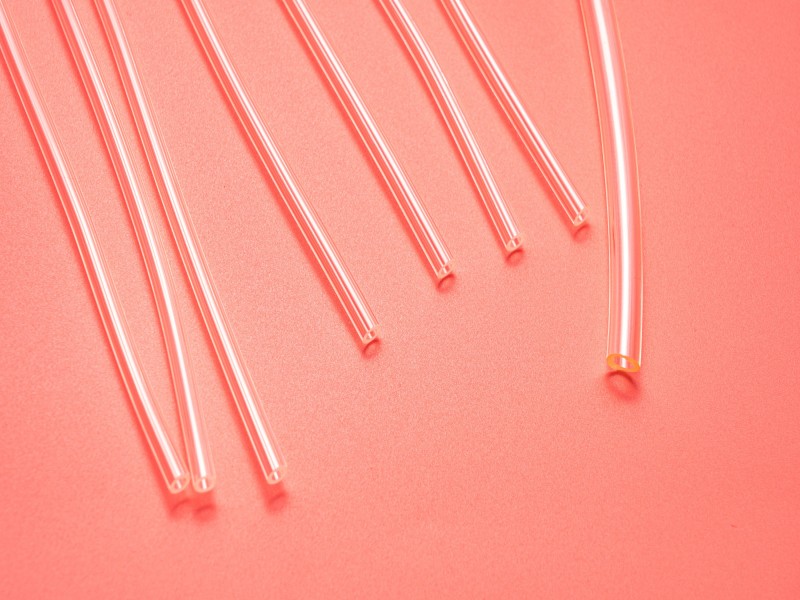
What separates a basic material from a lifetime component?
Tight granular control on molecular weight distribution—not just the “average.”
Tailored additive packages that address specific OEM fluids and temperatures.
A supplier like Shanghai Xingen who invests in rheology lab testing to predict real-world processing and performance, not just sell pellets off a shelf.
In your next prototype, don’t just accept the material datasheet. Demand the backup data. Test the cold impact, measure the fluid swell yourself, and push the flex fatigue limit until it cries uncle. When your parts survive that, you’ll know you specified it right.
The hidden details in polymer chemistry are what keep vehicles running past 200,000 miles. Make those details count.

