

The inflatable products industry is undergoing a quiet but decisive material shift. For decades, PVC (polyvinyl chloride) coated fabrics dominated the market—from inflatable boats and paddleboards to medical air cushions and industrial airbags. But walk through any serious manufacturer’s trade show booth today, and you’ll see a different story. TPU (thermoplastic polyurethane) laminated fabric is steadily taking over.
This isn’t a fringe trend. It’s a structural change driven by regulation, consumer demand, and hard-nosed performance data. In this article, I’ll break down exactly why TPU is winning, with practical takeaways for anyone sourcing or specifying inflatable materials.
1. Environmental and Regulatory Pressure Is Killing PVC
The European Union’s REACH regulation has progressively restricted phthalate plasticizers—the very chemicals that make PVC flexible enough for inflatables. DEHP, DBP, and BBP are already classified as Substances of Very High Concern.
Meanwhile, PVC production itself involves chlorine chemistry and releases dioxins during incineration. Major outdoor brands have publicly committed to phasing out PVC by 2025–2030.
TPU, by contrast, is free of plasticizers and chlorine. It can be formulated to meet FDA, EU 10/2011, and ROHS standards without reformulation headaches.
Practical tip: If you export inflatables to Europe or North America, ask your material supplier for REACH and ROHS compliance certificates upfront. Don’t wait until customs flags your shipment.
2. Performance: TPU Wins on Durability and Cold Flexibility
Here’s where the data gets interesting. PVC plasticizers migrate over time—this is why older PVC inflatables become stiff, brittle, and prone to cracking. TPU doesn’t have this problem because it achieves flexibility through its polymer structure, not additive leaching.
Field tests consistently show TPU laminated fabrics maintain flexibility at temperatures from -40°C to 80°C. PVC typically becomes rigid below -10°C to -20°C, depending on plasticizer content.
For inflatable boats, rescue equipment, and cold-weather camping gear, this temperature window is the difference between a reliable product and a liability.
Practical tip: Specify cold bend testing (ASTM D2137 or equivalent) when evaluating suppliers. A TPU film from a qualified manufacturer should show no cracking at -40°C after 4 hours.
3. Abrasion Resistance and Puncture Strength
TPU films consistently outperform PVC in Taber abrasion tests. Depending on formulation, TPU can achieve 2–3x the abrasion cycles of comparable PVC coatings at similar thickness.
This matters for inflatable paddleboards, whitewater rafts, and any product that contacts abrasive surfaces like sand, rock, or concrete.
At Shanghai Xin Gen Tech Co., Ltd. (Xin Gen Tech), the company’s high-end TPU films are engineered for exactly these demanding applications. Founded in 2009 with headquarters, R&D, and manufacturing in Shanghai covering over 6,000 square meters, Xin Gen Tech expanded with sales branches in Shenzhen and Los Angeles in 2023.
Practical tip: Request tear strength and abrasion test data from your fabric supplier. Compare at equal weight per square meter, not equal thickness—TPU’s lower density means thickness comparisons can be misleading.
4. Weldability and Manufacturing Efficiency
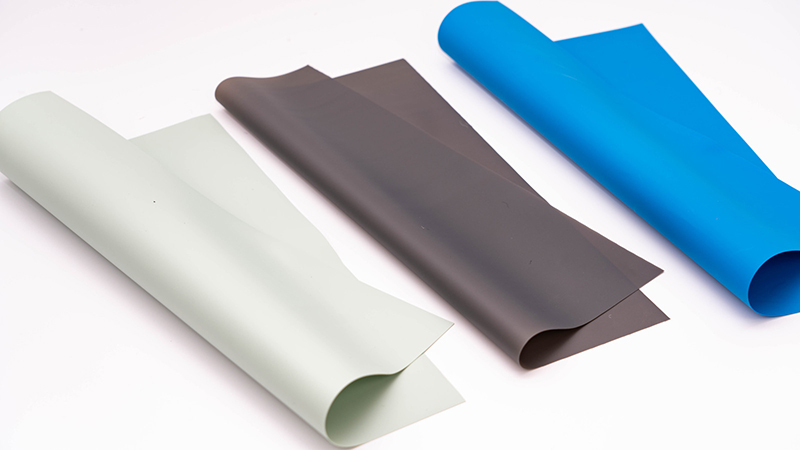
TPU laminated fabrics can be welded using RF (radio frequency), hot air, or ultrasonic methods. The weld strength typically exceeds the substrate strength, meaning the fabric tears before the seam fails.
PVC also welds well, but the process window is narrower. Overheating PVC releases hydrogen chloride gas, which corrodes equipment and creates workplace safety issues.
TPU’s wider processing window reduces scrap rates and speeds up production. For high-volume inflatable manufacturers, this directly impacts the bottom line.
Practical tip: Before committing to a full production run, request lamination and welding trials from your TPU film supplier. Xin Gen Tech, for example, operates in-house lab equipment that simulates mass production lines on a 1:1 basis—sample width 400mm, with fast lead times and low sampling costs.
5. Weight Reduction Without Sacrificing Strength
TPU films can be formulated at lower densities than PVC coatings while maintaining equivalent mechanical properties. For inflatables where every gram matters—backpacking pads, ultralight packrafts, drone-deployed emergency floats—this is significant.
A 15–20% weight reduction in the fabric translates directly to lighter finished products, better packability, and in some cases, improved fuel efficiency in marine applications.
Practical tip: Ask for specific gravity data and calculate total fabric weight per square meter including adhesive layers. The lightest coating isn’t always the lightest finished laminate.
6. Medical and Specialty Applications Demand TPU
Medical-grade TPU is biocompatible, non-toxic, and sterilizable. It’s already the material of choice for wound dressings, medical catheters, and inflatable pressure relief cushions. PVC simply cannot match this biocompatibility profile without significant formulation compromises.
In specialty fields like bulletproof glass lamination—a field where Xin Gen Tech has documented case studies in Brazil—TPU films provide stable adhesion between polycarbonate and glass while maintaining optical clarity. This is a performance envelope PVC cannot reach.
Xin Gen Tech’s recent appearance at the 2025 Shanghai CMEF underscored how innovative medical materials are shaping the future of healthcare products.
7. The Certification and Trust Gap
When specifying materials for regulated markets, certifications matter. Xin Gen Tech holds ISO 9001:2015, OHSAS 18001:2007, OEKO-TEX, SGS, ROHS, REACH, FDA, and EU 10/2011 certifications, supported by an in-house R&D center and product laboratory.
PVC suppliers can also achieve certifications, but the phthalate issue creates ongoing compliance risk as regulations tighten.
Practical tip: Look beyond the certificate itself—ask how often the supplier’s in-house lab calibrates equipment and whether they can provide batch-specific test reports.
My Take
The shift from PVC to TPU in inflatables isn’t just about environmental correctness. It’s about total cost of ownership: fewer warranty claims from cracked seams, lower scrap rates during welding, and access to premium markets that have already banned PVC.
For manufacturers still on the fence, my advice is straightforward. Start with a sampling program on your highest-value product line. Test weldability, cold flexibility, and abrasion resistance side by side. Let the data make the case.
The material transition is already underway. The question is whether your product line will be ahead of it or playing catch-up.

