

As global regulations tighten and corporate ESG commitments move from marketing slides to procurement checklists, the demand for sustainable thermoplastic polyurethane (TPU) tubing has shifted from a “nice-to-have” to a “must-have.” By 2026, the landscape will be radically different from today. Here’s what data says, what actually works, and how to source without compromising performance or cost.
The Market Reality: Why 2026 is the Tipping Point
The global TPU market is projected to reach $3.8 billion by 2026, growing at a CAGR of 5.7%. But the more interesting segment is recycled and bio-based TPU, which is expected to grow at 9.2% CAGR, outpacing conventional materials. This isn’t just environmental sentiment—it’s economics. For instance, the European Union’s Single-Use Plastics Directive and the upcoming Packaging and Packaging Waste Regulation (PPWR) are forcing manufacturers to account for the entire lifecycle. In 2025, a major German automotive supplier disclosed that 23% of its requested material specifications now require a minimum of 30% recycled content or bio-attributed feedstock.
The practical takeaway: If you haven’t started qualifying sustainable TPU grades, your product roadmap is already behind schedule.
1. Mechanically Recycled TPU: The Pragmatic Workhorse
What It Is
Post-industrial (PIR) and post-consumer (PCR) TPU scrap is collected, sorted, and re-compounded. PIR is the low-hanging fruit—factory offcuts, rejected parts, and purge material. PCR is harder due to contamination and color inconsistency.
The Numbers That Matter
A 2024 study by the Fraunhofer Institute found that high-quality mechanically recycled TPU can retain 85-92% of tensile strength and 90-95% of elongation at break compared to virgin grades, provided the feedstock is clean and the processing temperature is controlled.
Leading compounders now offer grades with 40-70% recycled content for tubing applications, usable in pneumatic lines and low-pressure fluid transfer.
My View on the Hype
Don’t expect “closed-loop” perfection in tubing. Thin-wall tubing (under 1mm) is unforgiving. A 0.5% contaminant speck becomes a pinhole leak. Start with PIR for internal routing tubes and non-critical applications, and climb the performance ladder gradually.
Operational Advice
Specify “recycled content” by mass balance or physical content? Choose physical content for transparent marketing, but accept mass balance for cost efficiency. The difference might be 8-12% in price premium.
Require a test report on your actual tubing, not just the raw pellet data. Extrusion of recycled grades demands a wider processing window. Set up a trial run with your converter using their standard cooling tank and puller speeds.
Build a “recycled grade changeover” plan. In production, reduce purge losses by switching to recycled grades for long runs, not short batches.
2. Bio-Based TPU: Not All “Bio” Is Equal
Two Schools of Thought
Non-food biomass: TPU made from castor oil or waste vegetable oils. These are chemically identical to petroleum-based TPU but have a renewable carbon content of 30% to 90%.
Bio-attributed monomers: Using ISCC PLUS certification, the bio-feedstock is allocated to the final product via a mass balance chain. This is essentially “green accounting,” but it drives real investment in bio-refineries.
The 2026 Game Changer
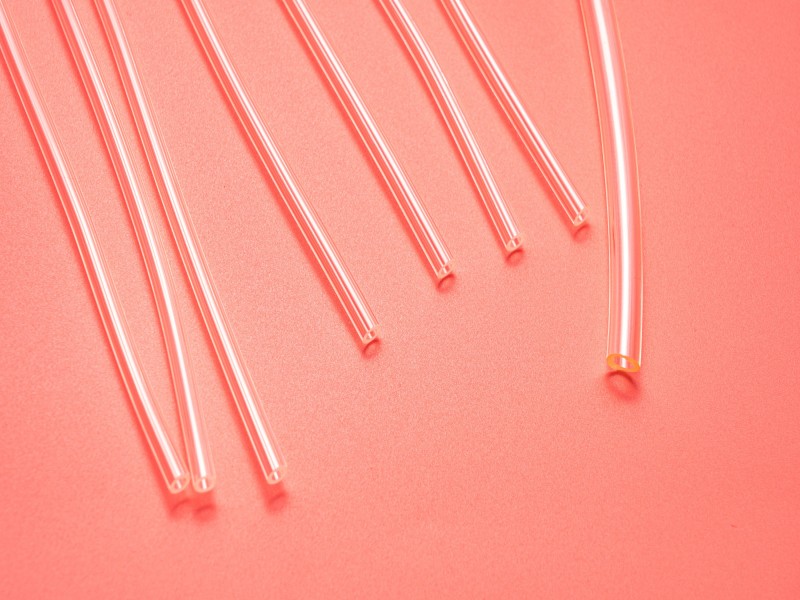
By late 2025, major TPU suppliers have started commercializing grades with 48% bio-circular content, using feedstocks from used cooking oil (UCO) and tall oil. The price premium has dropped from a 50% markup to 15-25% as volume ramps up. In specific small-bore tubing (e.g., medical device pump tubes), bio-based TPU with 65 Shore A hardness shows excellent kink resistance and low extractables.
A Word of Caution
Many “bio” grades show lower hydrolysis resistance. If you’re in a humid environment or contact with warm water (above 40°C), demand long-term aging data (e.g., 6 months in 70°C water) before switching. I’ve seen a startup fail because their bio-based TPU degraded in a hot beverage dispenser that used steam cleaning.
Practical Steps
Push for the “renewable carbon index”, not just “bio-based content.” Some materials are 70% bio-based but only 40% renewable carbon if the bio-monomer is only part of the polymer chain.
Test contact with your specific fluids. IPA and some disinfectants can swell bio-based TPU differently. Run a 7-day immersion test at your highest working temperature.
Request a “drop-in” grade that can run on your existing extrusion line without changing screw design. This saves you thousands in retrofitting costs.
3. Hybrid Approaches: The Reality Winner of 2026
Combining Recycled and Bio
The best sustainable sourcing strategy in 2026 is not choosing one or the other, but a hybrid profile. For example, a tube with a core layer of 50% bio-based TPU and a skin layer of 20% recycled TPU can achieve:
40% reduction in carbon footprint (cradle-to-gate, per LCA data from a 2025 peer-reviewed study)
Competitive pricing (only 18% higher than virgin)
Acceptable optical clarity if the skin layer uses a high-clarity recycled grade
Why This Wins
Because material properties are layered, you avoid the weakness of recycled material (color and impurities) on the outside, while shielding the bio-core from direct chemical attack. The technical hurdle is co-extrusion adhesion. Not all TPU grades bond perfectly to each other.
How to Execute
If you lack co-extrusion capability, consider a monolayer tube made from a “post-industrial recycled + bio-blend” that is off-the-shelf. Companies like Shanghai Xingen have developed proprietary blend formulas that maintain clarity and flexibility for medical and pneumatic applications. Their premium tubing line now uses 60% sustainable content without compromising burst pressure ratings.
Ask for a “dual certification”—your tube should carry both a recycled-content certificate (e.g., GRS) and a bio-content certificate (e.g., ISCC PLUS). This avoids greenwashing audits down the road.
Don’t forget end-of-life. A tube made from bio-based TPU is still non-biodegradable in a standard landfill. The real goal for 2026 is to ensure that your tube, at the end of its life, can go back into a chemical recycling stream. Check if your supplier is part of a take-back program for scrap regrind.
The Cost Equation: Turning a Liability into an Asset
Many sourcing managers think sustainable TPU is more expensive. True, virgin-grade bio-based TPU costs $4.20/kg, while petroleum-based virgin is $2.80/kg. But when you consider:
Carbon tax costs under EU CBAM, which may add 10-15% to imported virgin TPU by 2026.
Brand premiums: In consumer appliances, a visible “Made with 30% recycled TPU” label can support a 12% higher retail price, based on 2025 consumer surveys.
Regulatory risk avoidance: Non-compliance with upcoming recycling content mandates can lead to fines of up to 4% of annual turnover in certain EU states.
The net total cost of ownership is increasingly favoring sustainable options, especially for high-volume standard tubing.
A Vision for 2026: Sourcing is No Longer a Form
In two years, you won’t ask, “Is there sustainable TPU?” You will ask, “Which sustainable TPU grade matches my exact durometer and chemical resistance?”
Standardization bodies like ISO are working on a new “bio-circular content” assessment that will unify claim reporting. But don’t wait.
Next 90 days action plan:
Audit your three highest-volume TPU tube SKUs. Identify which one is least critical in terms of pressure and chemical exposure.
Request samples of both mechanically recycled (PIR) and bio-based grades from your existing supplier and one new challenger.
Run a baseline physical test (tensile, tear, shore hardness) on your current virgin grade. Then run the same tests on the sustainable samples. Compare the processing melt flow index—sustainable materials often process like a more viscous grade.
Negotiate a blanket purchase order for a trial production run of 5,000 meters. Don’t commit to full conversion until you see yield rates above 95%.
Forward-looking manufacturers will treat this not as an expense, but as an engineering challenge—one that yields better margins, lower regulatory risk, and a durable brand story. The technology is already here. The only missing piece is your decision to test it in 2026.

