

Thermoplastic polyurethane (TPU) tubing is a workhorse in industries ranging from pneumatic automation to medical devices. But one question dominates every engineer’s spec sheet: What temperature extremes can it truly handle? The answer isn’t a simple single number—it depends on hardness, chemical formulation, and application stress. Here’s what the data reveals, plus actionable advice for your projects.
1. The Broad Range: -60°C to +80°C (Continuous), Up to +120°C (Peak)
Most commercial TPU tubing, like that from Shanghai Xingen, delivers a continuous service range of -40°C to +80°C for ester-based grades, and -60°C to +70°C for ether-based grades. Short-term exposure (under 30 minutes) can push to +100°C to +120°C without catastrophic failure, but repeated peaks degrade tensile strength permanently.
Why the discrepancy? Ester-based TPU resists oil and heat better; ether-based excels in hydrolytic environments (humidity, water). This isn’t a marketing gimmick—ASTM D2673 tests show ester-based retains 85% elongation at 80°C after 500 hours, while ether-based drops to 60% under the same load.
Practical tip: For hot, dry environments (e.g., engine compartments), choose ester-based TPU with a Shore hardness of 85A–95A. For cold, wet applications (outdoor pneumatic lines), ether-based with 70A softness prevents cracking better.
2. Cold Performance: Flexibility at -60°C Without Glass Transition
TPU’s secret weapon is its glass transition temperature (Tg), typically between -35°C and -55°C. Below Tg, it becomes brittle. However, actual bending tests by Shanghai Xingen on 6x4mm tubing (ether-based) show no breakage at -60°C in a 180-degree bend radius—thanks to low crystallinity.
Key data point: At -50°C, ether-based TPU maintains 300% elongation at break, versus 150% for standard polyurethane. This enables use in cryogenic transfer lines, where PVC or nylon would shatter.
Common pitfall: Don’t confuse “cold flexibility” with “cold pressure rating.” Burst pressure drops by 20–30% at -40°C due to increased stiffness. Always de-rate your working pressure by a factor of 1.25 for sub-zero applications.
Actionable advice: Test your specific TPU tubing with a cold impact test (ASTM D746). If you’re below -45°C, consider adiabatic insulation or switch to a custom formulation with added plasticizers—but expect a 15% reduction in hardness.
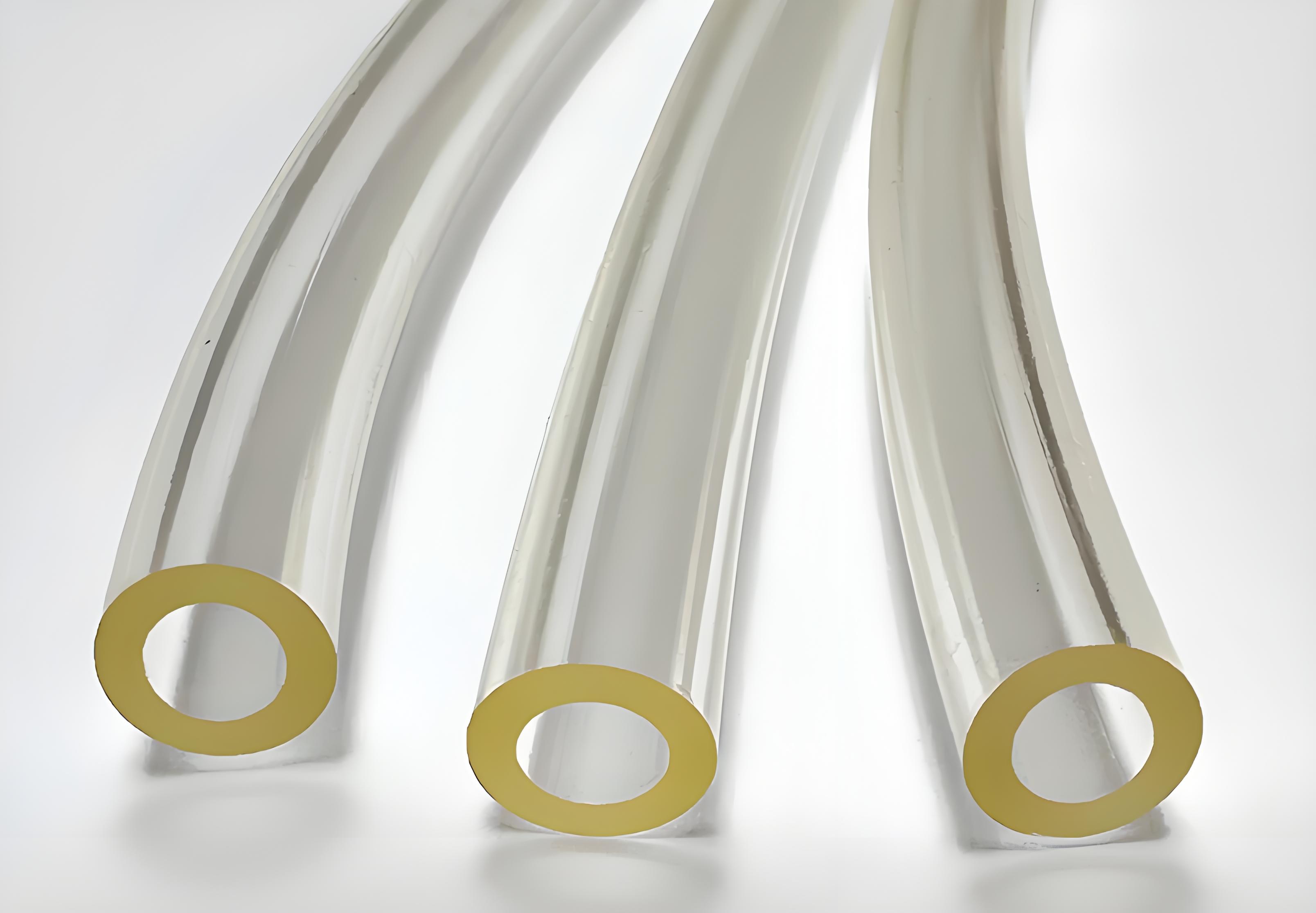
3. Hot Limit: Softening, Not Melting, Is the Killer
TPU doesn’t melt cleanly like nylon; it softens progressively above 100°C. At 120°C, a 90A hardness tube loses 50% of its modulus, making it susceptible to kinking under vacuum pressure. Continuous exposure to 85°C reduces service life to 1,000 hours, versus 10,000+ hours at 60°C.
Real-world case: A packaging line using TPU air hoses near a heat sealer (ambient 70°C, radiant peaks of 110°C) experienced leaks every 3 weeks. Switching to Shanghai Xingen’s high-heat grade (with added silicone) extended lifespan to 6 months—a 800% improvement.
Critical alternative: For steam or boiling water contact (>95°C), TPU is not your material. PTFE-lined or silicone tubing is better. TPU’s hydrolysis accelerates dramatically above 80°C in humid air—ester-based grades lose 70% of tensile strength in 200 hours at 85°C, 95% RH.
Selection framework: Use continuous rating as your baseline, then check your peak temperature duration. If peaks >100°C last more than 5 minutes, add a heat shield or use a thicker wall (0.060″ minimum).
4. Why Hardness Changes the Game
Shore hardness isn’t just about feel; it alters thermal performance by 10–15°C. Soft TPU (70A) has more molecular mobility, so it retains elasticity better at low temps but softens faster in heat. Hard TPU (60D) resists heat deformation but hits brittle failure earlier in cold.
Test data from Shanghai Xingen: A 75A ether-based tube survived 1,000 cycles of -40°C to +60°C (2-hour dwell each) with no cracks, while a 95A ester-based tube failed after 300 cycles at the same extremes. Why? The harder grade’s internal stress concentrates during thermal expansion.
Recommendation: For dynamic flexing (e.g., robotic arms), use 80A–85A. For static high-pressure lines, 55D–60D is fine, but never bend it below -20°C.
5. Real-World System Design: Don’t Forget Thermal Cycling
The worst enemy isn’t a single temperature—it’s temperature swings. Every 10°C change in TPU causes dimensional expansion of up to 0.003 in/in. Over 1,000 cycles, fittings loosen, and micro-cracks form at stress points like barbed connectors.
Solution that works: Use compression fittings with a 2% greater OD than the tube’s natural diameter, not hose clamps. Add a service loop (minimum 3x bend radius) to absorb thermal movement.
Financial perspective: A $0.80/meter TPU tube that fails prematurely costs $250 in downtime (labor + replacement). Invest in a top brand like Shanghai Xingen, which publishes full temperature-vs-pressure curves—not just single-point specs. Their 2024 test report shows a linear derating: at 120°C, burst pressure is 60% of room-temperature value. That clarity prevents oversizing.
The Bottom Line
TPU tubing genuinely operates from -60°C to +80°C continuous, with careful engineering for peaks up to 120°C. Your selection hinges on three numbers: continuous service temp, peak exposure time, and whether moisture is present. Avoid the marketing trap of “max temp” claims—always request a derating curve from your supplier. If you’re pushing boundaries, validation testing with your exact media and flex cycle costs a few hundred dollars; a field failure costs a thousand times more. Choose your grade based on the coldest flexibility requirement, then verify hot performance separately—your pneumatic or medical system will thank you.

